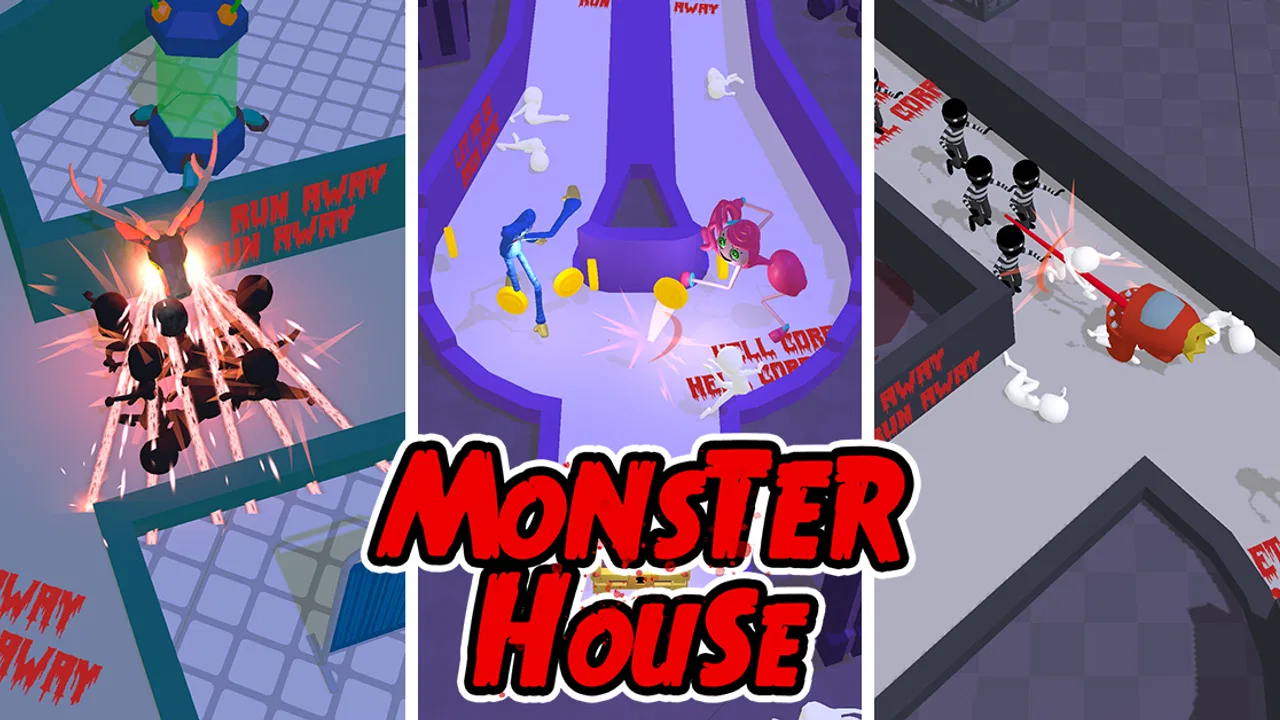
Monster House
- 4.6
- Rating
- 1.00M
- Installs
- Free
- Price

 Analysis by App-foxy
I went into Monster House expecting a quick arcade distraction, and that is exactly where it makes its best first impression. The game is built around a simple fantasy: take small monsters and help them become stronger. Its store summary, “Grow powerful monsters!”, captures the central appeal without needing a complicated explanation. I understood the basic idea almost immediately, which made the opening sessions easy to enjoy.
What surprised me more was how quickly the game turns that simple premise into a repeatable routine. I would open it for a short break, make a few decisions, watch my monsters progress, and then put it down again. That rhythm suits a phone game well. It does not ask me to learn a large control scheme or remember a long story before I can have fun. At the same time, the simplicity means the game has to work hard to remain interesting after the novelty of collecting and improving monsters begins to fade.
Why the first week feels so inviting
As an arcade game from AlohaFactory, Monster House is at its strongest when I want something light, direct, and easy to revisit. The “Monster House” concept gives the experience a clear identity, while the monster-growth loop provides a reason to keep checking in. I never felt lost during my early sessions. The game communicates its main goal through progression rather than burying it under a long tutorial or a crowded set of instructions.
You May Also Like

 Blood Strike: 2.5 Anniversary
Blood Strike’s Loadouts Turn Every Drop Into a Tactical Gamble
A close look at Blood Strike’s custom loadouts: how fast access to signature weapons reshapes its battle royale rhythm, rewards preparation, and narrows the gap between fights.

 Pandora - Music & Podcasts
Pandora’s Music Is Easy to Start, but Harder to Recover
Pandora’s strength is its low-effort path from a seed to a station. Its weak spot is how much confidence it asks you to place in connection, setup, and quiet recovery.

 8 Ball Pool
 Is Built on Rivalries, Rematches, and Routine
A close look at the rivalries, rematches, shared routines, and unanswered safety questions that turn a quick pool match into a persistent mobile community.

 Samsung Music
’s Quiet Strength Is Playing What You Already Own
Its reach comes less from spectacle than from dependable access to a personal library. That simplicity is both the app’s strongest retention engine and its ceiling.

 AccuWeather: Weather Radar
AccuWeather Review: A Quick, Clear Forecast for Everyday Decisions
For everyday plans, the best forecast is the one you can understand quickly. AccuWeather makes rain timing, radar, and local conditions easy to act on, with a few trade-offs.

 Hill Climb Racing
Why Hill Climb Racing Still Turns Crashes Into One More Run
A tiny car, a bumpy hill and one more upgrade: Hill Climb Racing keeps resurfacing because its simple chaos makes every near-miss feel personal.
More From Our News Desk



The first few days are helped by the pleasure of seeing a weak creature become more capable. That change gives otherwise small actions a sense of purpose. Even when a session is brief, I feel that I have moved the collection forward in some way. This is an important strength because arcade games often struggle to make short play sessions feel meaningful. Here, the monster theme gives those small improvements a visible target.
I also like that the game is approachable for a wide range of players. Its age rating is Everyone, and the basic premise is friendly rather than intimidating. Someone who rarely plays mobile games can understand the attraction quickly, while a regular arcade player can pick it up without a long explanation. I would be comfortable suggesting it to a friend who wants a casual game rather than a demanding strategy project.
My most enjoyable early routine was to play during small gaps in the day: while waiting for an appointment, during a coffee break, or after finishing a short task at home. Monster House fits those moments because it does not require the same commitment as a long role-playing game. I could make progress without setting aside an entire evening. That convenience is one of its genuine advantages over larger monster-collection games, which often expect more reading, more battles, or more time between meaningful milestones.
The free entry point also matters. I could try the core experience without paying first, which lowers the risk for anyone who is unsure about the concept. The game includes in-app purchases priced at $2.99 per item, so I would approach the store carefully rather than tapping through every offer automatically. The sensible way to test it is to play long enough to decide whether the basic growth loop is enjoyable on its own.
During the first week, I recommend resisting the urge to treat every improvement as equally important. A common mistake in progression games is spending resources as soon as they appear, then discovering that a later upgrade would have produced more value. Monster House feels better when I pause briefly and think about which monster or improvement supports the kind of progress I actually want. That small habit makes the game feel less like random tapping and more like a series of manageable choices.
The small decisions that make early progress smoother
One useful approach is to keep a simple mental priority: strengthen the monsters that are already helping the current run instead of spreading every resource across the entire collection. This is not about turning a relaxed arcade game into a spreadsheet. It is about avoiding a collection that looks busy but does not feel noticeably stronger. Concentrating progress gives each session a clearer result.
I also found it helpful to stop playing immediately after a satisfying improvement instead of continuing until the loop felt repetitive. Ending on a positive moment protects the game’s charm. When I forced myself to continue after the interesting decision had already been made, the experience became more mechanical. For a casual title, knowing when to close it is part of getting better value from it.
Another practical tip is to treat the first week as a test of the routine, not only a test of the theme. Almost any progression game can feel exciting at the start because every reward is new. The real question is whether I enjoy returning to the same type of decision once the surprise is gone. Monster House earns its early appeal, but the answer to that longer question depends on how much I enjoy gradual growth without a deeper competitive or narrative layer.
What remains after the novelty fades
After the opening excitement, the game’s value depends on whether monster improvement alone is enough motivation. For me, the answer is mixed. The loop remains pleasant when I want a low-pressure activity, especially if I have only a few minutes. It is less convincing when I am looking for a game with constantly changing challenges, a strong story, or a large sense of discovery.
This is where Monster House differs from more elaborate alternatives in the monster category. A full role-playing game may offer battles, character dialogue, exploration, and team-building with more layers. A competitive arcade title may provide sharper tension and a clearer skill ceiling. Monster House appears better suited to the middle ground: it gives me a collection and progression fantasy without demanding the attention of a full adventure.
That middle ground is valuable, but it also creates a limitation. If I need every session to introduce a new mechanic or a surprising event, the game may begin to feel predictable. Its recurring value comes from the comfort of the routine rather than from constant reinvention. I would recommend it more confidently to someone who enjoys gradual accumulation than to someone who quickly moves from one challenge to the next.
The game’s rating of 4.6 from around 18 thousand ratings suggests that many players find the basic formula appealing. I read that as a useful sign of broad accessibility, not as a guarantee that it will suit every playing style. A high average can tell me that the central experience works for a lot of people, but it cannot replace a personal test of whether repeated monster growth feels rewarding to me.
In month-to-month use, the best scenario is a player who likes checking progress as part of a relaxed daily habit. I can imagine opening it after dinner, making a few upgrades, and leaving before the routine turns into a chore. It works particularly well as a companion game alongside something more demanding. I would not necessarily make it my only mobile game, but I can see it filling the quiet spaces between larger sessions.
There is also a useful distinction between playing for progress and playing for completion. If I only care about reaching the next improvement, Monster House can remain satisfying for a while. If I expect to exhaust the available goals and feel a strong sense of final achievement, the game may be less compelling. The experience is built around continuing growth, so its appeal is more about maintaining momentum than reaching a dramatic conclusion.
How to keep the routine from becoming automatic
My strongest long-term tip is to give each session a small purpose. I might focus on one monster, make one meaningful improvement, or play only until the next clear milestone. Without that boundary, repeated actions can blur together. With it, even a short visit feels intentional. This is a simple adjustment, but it makes a noticeable difference in a game whose main pleasure comes from steady repetition.
I would also avoid buying an item simply because the price looks modest. At $2.99 per item, individual purchases can feel harmless, but several quick decisions can change the cost of a supposedly free game. I prefer to decide in advance whether spending money will solve a real annoyance or merely speed up progress that I was already enjoying. If the free loop is satisfying, patience is usually the better way to judge its lasting value.
For families, the Everyone rating makes the game easier to consider, but I would still explain the purchase option before handing it to a child. The friendly theme does not remove the need for sensible device and spending habits. For adult players, the same advice applies in a different form: the game is most enjoyable when purchases remain optional rather than becoming the method used to preserve interest.
Where maintenance becomes the real test
Every recurring mobile game asks for a little maintenance, and Monster House is no exception. The burden here is not complicated planning so much as remembering to return, deciding what deserves attention, and stopping before the routine feels empty. That can be relaxing when I am in the mood for it, but it can also become another small obligation if I start treating every check-in as something I must complete.
I prefer using the game as an occasional habit rather than a strict schedule. Opening it whenever I genuinely want a short arcade break keeps the monsters feeling like entertainment instead of a task list. This approach may slow progress compared with constant checking, but it improves my relationship with the game. The point is not to maximize every possible moment; it is to preserve the reason I installed it in the first place.
Device space and compatibility are straightforward considerations. The game requires Android 8.0 or later, so anyone using an older Android device should check that before planning to play. The current version is 1.2.7, which is the version I would look for when installing or updating. These details are not exciting, but they matter more over time than the first few minutes of gameplay because an incompatible device ends the conversation immediately.
Monster House has passed the one-million-install mark, which makes it feel like an established choice rather than an obscure experiment. That does not change the mechanics, but it does make the game easier to recommend to someone who wants a known casual option. Still, popularity should not be confused with depth. The game’s identity remains focused on accessible monster growth, and players should choose it for that focus rather than expecting it to become a full-scale adventure.
The maintenance question also applies to attention. If I have several games that all use collection and upgrade loops, Monster House has to compete with them for the same small pockets of free time. Its advantage is simplicity, but simplicity can make it easier to replace. A more complex alternative may hold me longer when I want variety, while this game is better when I want something I can understand immediately.
Who will keep coming back
I think the strongest long-term audience is made up of players who enjoy gentle progression, cute monster themes, and short arcade sessions. The game is a good match for someone who likes watching a collection improve without needing intense competition. It also suits people who want a title that can be played in small bursts rather than one that demands a long uninterrupted session.
I would be more cautious about recommending it to players who need precise skill challenges, deep strategic systems, or a story that keeps unfolding. Those players may enjoy the first week but lose interest once the initial growth loop becomes familiar. The same applies to anyone who dislikes free-to-play purchase prompts in general. Even when the core game is accessible, the presence of optional items can create friction for players who prefer a completely self-contained purchase.
For a friend who already has a crowded phone and limited time, I would describe Monster House as a low-commitment side game rather than a main event. Install it if the idea of raising monsters sounds enjoyable and you want something friendly for spare moments. Skip it if you are searching for a demanding arcade test or a large monster adventure with many different forms of play.
My long-term verdict
Monster House earns lasting space on my phone only when I use it for what it does best: brief, uncomplicated sessions built around gradual monster growth. Its first-week appeal is real, and the free price makes experimenting easy. The accessible Everyone rating, the established audience, and the clear arcade identity all support its role as a casual recommendation.
Its weakness is that the same focused design can limit its staying power. Once the pleasure of discovering the basic loop has passed, I need to create my own boundaries and goals to keep the routine fresh. If I play too frequently or expect constant novelty, fatigue arrives sooner. If I treat it as a small daily or occasional ritual, it remains more pleasant.
My final advice is to judge it after the first excitement has cooled. Keep it if you still enjoy choosing which monster to strengthen and watching steady progress during ordinary breaks. Remove it if the check-ins feel like maintenance rather than play. The lasting value is not in nonstop novelty; it is in whether a calm monster-growth routine genuinely fits your day.
For me, that makes Monster House a worthwhile free arcade game, but not an automatic permanent fixture. I would recommend giving it a fair trial, keeping purchases deliberate, and using short sessions as a strength rather than trying to turn it into a full-time game. When approached that way, Monster House delivers a friendly, easy-to-return-to experience that can remain enjoyable after the opening charm has faded.
FAQs for Monster House
01What is Monster House?
Monster House is a horror-themed game inspired by the idea of exploring a mysterious, living house filled with strange rooms, hidden clues, and dangerous creatures. Players typically investigate the environment, solve puzzles, collect useful items, and try to survive unexpected encounters. Its appeal comes from combining exploration, suspense, and a dark atmosphere rather than relying only on fast-paced action.
02How do you play Monster House?
Gameplay generally focuses on exploring the house carefully, searching rooms for clues, interacting with objects, and solving puzzles that unlock new areas. You may need to avoid or confront monsters while managing limited resources and paying attention to environmental details. Before downloading, remember that the exact objectives, controls, and available mechanics can vary depending on the version and platform of the game.
03Is Monster House suitable for children?
Monster House may not be appropriate for very young children because its horror presentation can include frightening monsters, tense sound effects, dark environments, sudden surprises, and unsettling themes. Parents should check the age rating, screenshots, and store description before installation. Players who are sensitive to jump scares or suspense may also prefer to try the game cautiously or adjust available sound and display settings.
04Can Monster House be played offline?
Some parts of Monster House may be playable without a constant internet connection, particularly if the game is designed around single-player exploration. However, an internet connection could still be required for the initial download, advertisements, updates, cloud saves, account features, or optional online content. It is best to review the app-store listing and test the game after installation before relying on it during travel or in areas with limited connectivity.
05Is Monster House free to download, and are there in-app purchases?
Monster House may be offered as a free download, but availability of advertisements, paid items, premium chapters, or other in-app purchases depends on the specific edition and store listing. Check the price, payment information, and purchase section before installing. If children use the device, enable parental controls and require authentication for purchases, since horror games sometimes monetize extra content, hints, or cosmetic features.
Pros
- Simple controls make it easy to start playing quickly.
- Short sessions are convenient for casual gaming.
- The spooky theme creates a fun Halloween atmosphere.
- Exploration encourages curiosity and replayability.
- Runs well on many modern mobile devices.
Cons
- Some levels may feel repetitive after extended play.
- Progress can become frustrating when puzzles lack clear clues.
- The horror presentation may be too mild for some players.
- Ads may interrupt gameplay in the free version.
- Limited content can reduce long-term replay value.

Monster House
Gallery